


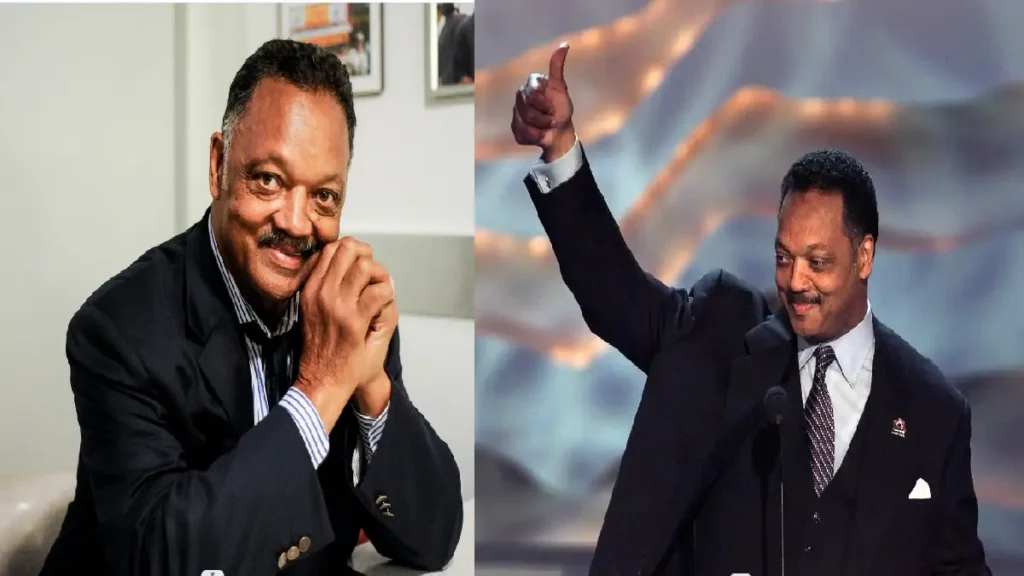
Jesse Jackson Dies at 84, marking the end of an era for the American civil rights movement. He was the civil rights leader who marched alongside Martin Luther King Jr. and later mounted two historic presidential campaigns. According to his family, Jackson passed away peacefully on Tuesday morning surrounded by loved ones, closing the chapter on a life devoted to justice, equality, and political empowerment.
“Our father was a servant leader, not only to our family, but to the oppressed, the voiceless, and the overlooked around the world,” his family said in a statement. “We shared him with the world, and the world became part of our extended family.”
For decades, Jackson stood as one of America’s most recognisable moral and political voices—a bridge between the civil rights movement of the 1960s and the diverse coalitions that shaped modern American politics.
Jesse Jackson Dies at 84: A Life Shaped by the Civil Rights Movement
Born Jesse Louis Burns on October 8, 1941, in Greenville, South Carolina, Jackson grew up in the segregated South. Raised by his mother, Helen Burns, he later adopted the surname of his stepfather, Charles Jackson. A gifted student and athlete, he earned a football scholarship to the University of Illinois before transferring to North Carolina A&T State University, a historically Black institution that would shape his path toward activism.
In 1965, Jackson watched in horror as Alabama state troopers attacked peaceful protesters on the Edmund Pettus Bridge in Selma—a day remembered as “Bloody Sunday.” The following day, he organized fellow seminarians and traveled to Alabama to join King and other demonstrators in the Selma-to-Montgomery marches.
That decision changed his life.
Jackson soon became one of King’s protégés and rose quickly within the Southern Christian Leadership Conference (SCLC). In 1966, he was appointed head of Operation Breadbasket in Chicago, the SCLC’s economic justice arm. A year later, King named him national director. Jackson was present in Memphis in 1968 when King was assassinated at the Lorraine Motel—a moment that profoundly shaped his lifelong commitment to continuing the struggle for equality.
Building the Rainbow Coalition
After King’s death, Jackson founded People United to Save Humanity (PUSH) in 1971, advocating for economic empowerment, fair hiring practices, and corporate accountability. He later formed the National Rainbow Coalition, uniting minorities, working-class Americans, women, and marginalized communities under a broader political umbrella.
“You can’t eat a vote,” Jackson often said, underscoring his belief that civil rights and economic justice were inseparable.
In 1984, he launched a presidential campaign that reshaped American politics. Though he placed third in the Democratic primary, his campaign energized millions of new voters. In 1988, he ran again and finished second—the most successful presidential bid by a Black candidate until Barack Obama’s historic victory two decades later.
At the 1984 Democratic National Convention, Jackson delivered one of the era’s most memorable speeches: “Our flag is red, white, and blue, but our nation is a rainbow.” The phrase became emblematic of his vision for an inclusive America.
A Voice Beyond Elected Office
Jackson never held a nationally elected office, yet his influence extended globally. He negotiated the release of hostages abroad, advocated for Washington, D.C., statehood, and served as a special envoy to Africa under Bill Clinton. In 2000, Clinton awarded him the Presidential Medal of Freedom, the nation’s highest civilian honor.
Through the Rainbow PUSH Coalition, Jackson championed not only racial equality but also the rights of women, LGBTQ Americans, immigrants, and the economically disadvantaged. The Rev. Al Sharpton once described him as “a movement unto himself.”
Health Challenges in His Final Years
Jackson’s health had declined in recent years. In 2017, he publicly revealed a diagnosis of Parkinson’s disease, describing it as a “physical challenge” but vowing to remain active. Later, doctors confirmed he had been living with progressive supranuclear palsy (PSP), a degenerative neurological disorder affecting movement and balance.
Despite mounting health challenges, Jackson remained engaged in public life. His son, former Congressman Jesse Jackson Jr., said his father’s greatest legacy was bringing hope to people “who found themselves in dark places.”
Tributes Pour In
Leaders across the political spectrum paid tribute. President Donald Trump called Jackson “a force of nature,” while former President Obama described him as “a true giant.”
On election night in 2008, when Obama was projected to win the presidency, cameras captured Jackson in Chicago’s Grant Park, tears streaming down his face—a moment that symbolized how far the country had come since the days of Jim Crow and the civil rights marches.
Bernice King, daughter of Martin Luther King Jr., shared a photo of her father alongside Jackson, writing simply, “Both now ancestors.”
A Legacy That Demands Action
Public observances are expected in Chicago, where the Rainbow PUSH Coalition is headquartered. The family said details of a celebration of life will be announced soon.
Jackson is survived by his wife, Jacqueline, whom he married in 1962, six children—including Jesse Jackson Jr.—and several grandchildren.
In their statement, his family urged supporters to honor his memory not with monuments, but with continued activism. Justice. Equality. Love.
For more than six decades, Jesse Jackson refused to accept injustice as inevitable. He carried forward the dream ignited by Martin Luther King Jr., expanding it to embrace a broader, more inclusive vision of America.
His voice may be gone, but the movement he nurtured endures.
Other Post: Trump indirect involvement in Iran nuclear talks