


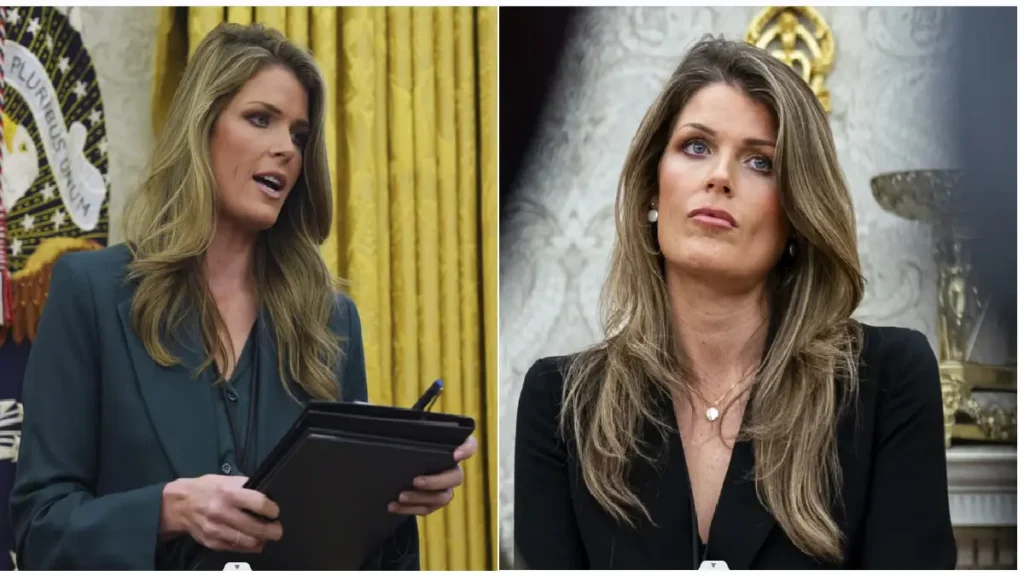
Lindsay Halligan has resigned from her role as U.S. Attorney for the Eastern District of Virginia after weeks of increasing pressure from federal judges who questioned the legality of her appointment and her conduct in court.
Judges had repeatedly asked Halligan to explain why she continued to present herself as the U.S. Attorney in court filings, even after a ruling in November found that her appointment was unlawful. Despite that decision, her name and title continued to appear on official court documents, which led to frustration and sharp criticism from the bench.
Why Lindsay Halligan Resigned
The situation escalated on Tuesday when federal judges took the unusual step of publicly inviting applications to replace Halligan. Her short and turbulent time in office was marked by several legal errors, according to the court.
Attorney General Pam Bondi announced Lindsay Halligan’s resignation late Tuesday night. Bondi said the decision came after a judge described Halligan’s attempt to remain in the role as a “charade.” Bondi defended Halligan and placed the blame on Virginia’s Democratic senators, who had refused to support Halligan’s confirmation in the Senate.
Calling her departure a loss, Bondi wrote on social media that Halligan would continue serving the country in other ways.
Halligan’s nomination for a full term as U.S. Attorney was still pending, but both of Virginia’s senators had made it clear they would not support her. Her exit finally ended months of tension between the Trump administration and the federal court in Eastern Virginia.
On the same day, U.S. District Judge David Novak warned that continuing to file documents listing Halligan as U.S. Attorney would be considered a false statement and a direct violation of court orders. In a strongly worded decision, Judge Novak said Halligan’s claim to the position could no longer continue.
He also criticized a recent Justice Department filing that defended Lindsay Halligan’s actions, saying its tone was more suitable for cable news debates than a federal courtroom.
Following the ruling, Lindsay Halligan’s office was instructed not to refer to her as U.S. Attorney in future filings. Instead, she was to be identified as a “special attorney,” as ordered by the court.
The dispute is part of a broader national debate over whether President Donald Trump followed the law while appointing temporary U.S. attorneys without Senate approval. Similar appointment strategies have reportedly been used in several other states.
Federal law allows judges to appoint an interim U.S. Attorney if the position is vacant and not confirmed by the Senate. The court’s recent actions suggest judges in Virginia are prepared to do just that. If a court-appointed prosecutor takes over, it is likely the president would attempt to remove that person and reinstall his preferred candidate.
Halligan was appointed in September after Trump removed her predecessor, even though she had no prior experience as a prosecutor. Soon after taking office, she announced investigations into two of Trump’s political opponents: former FBI Director James Comey and New York Attorney General Letitia James.
In a statement after her resignation, Lindsay Halligan accused federal judges of running a campaign to force her out, claiming the legal battle distracted her office from public safety work.
Meanwhile, Letitia James’s lawyer called Halligan’s resignation another failure in what he described as the administration’s unlawful effort to place political loyalists in prosecutorial roles. He said her exit marked an appropriate end to a troubled tenure.
Lindsay Halligan’s resignation came just hours after another judge criticized her courtroom conduct and warned of possible disciplinary action if court orders continued to be ignored. While the judge stopped short of imposing penalties, he noted her lack of prosecutorial experience and said she was being given the benefit of the doubt.
With Halligan gone, the court has formally begun searching for a new interim U.S. Attorney, signaling a decisive shift in control over the office’s future leadership.
Other Related Posts: Why Is Trump threatened to Use the Insurrection Act in Minnesota Amid ICE Protests