

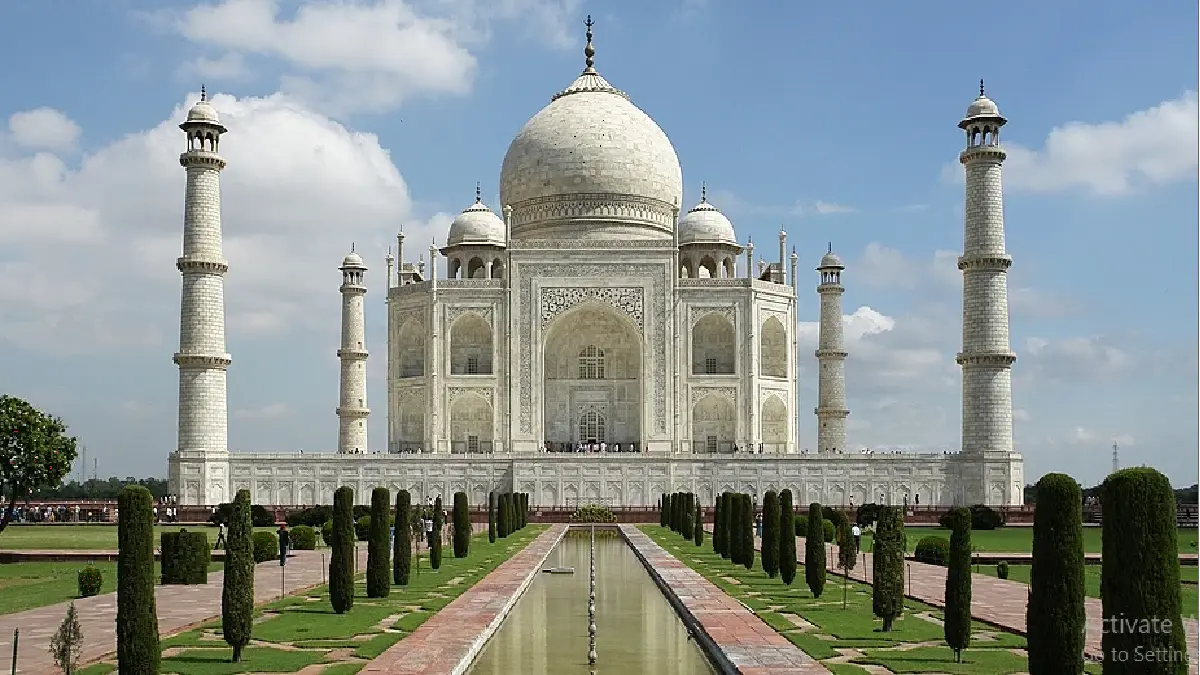
About the Taj Mahal
The Taj Mahal is located in Agra City, in the Uttar Pradesh state, India. It is located on the right bank of the Yamuna River in a vast Mughal garden. The Taj Mahal is a mausoleum complex that houses the tombs of Mumtaz Mahal and her husband, the Mughal emperor Shah Jahan. The Taj Mahal is built of white marble, which was brought in from all over India (Makrana in the Rajasthan state) and Central Asia.
That reflects hues according to the intensity of the sunlight or the moonlight. It is the finest example of Mughal architecture and Indian, Persian, and Islamic styles. Declared a UNESCO World Heritage Site in 1983, the Taj Mahal is also recognized as one of the New Seven Wonders of the World.
The Taj Mahal also plays a vital role in boosting India’s tourism sector, contributing significantly to the local economy of Agra. Tourists from across the globe visit the monument to experience its historical grandeur and emotional significance. Even centuries after its creation, the monument continues to inspire awe, love, and admiration worldwide.
Taj Mahal’s importance in the world
The Taj Mahal of Agra is one of the Seven Wonders of the World. The Taj Mahal is synonymous with love. The purity of the white marble, the exquisite ornamentation, the precious gemstones used, and its picturesque location—all these things make the Taj Mahal one of the world’s most iconic monuments.
The complex was designated a UNESCO World Heritage Site in 1983.
Other Post: India T20 World Cup 2026 Victory: India Defeats New Zealand to Win Historic Title
History of Taj Mahal
The Taj Mahal was built by Mughal Emperor Shah Jahan in memory of his third wife, Mumtaz Mahal. Its construction started in 1631, and the work on the mosque, the guest house, and the main gateway on the south was completed in 1648. and the outer courtyard and its cloisters were added subsequently, and the Taj Mahal was finally completed in the year 1653.
In total, construction of the 42-acre complex was completed in 22 years.
Ustad Ahmad Lahori was the main architect of the Taj Mahal.
For its construction, masons, stone-cutters, inlayers, carvers, painters, calligraphers, dome-builders, and other artisans were called from Central Asia, Iran, and India’s many states.
More than 20,000 workers and 1,000 elephants were employed from India and Europe to complete the mausoleum.
It was soon after the completion of the Taj Mahal that Shah Jahan was deposed by his own son Aurangzeb in the year July 1658 and was put under house arrest at nearby Agra Fort. Shah Jahan spent his final days in the Musamman Burj of the Agra fort, which was built by him. The Musamman Burj is located on the left of the Khaas Mahal. It is a beautiful octagonal tower with an open pavilion. It is said that Shah Jahan used to view the Taj Mahal from this very place. Shah Jahan was regularly seeing the Taj Mahal with love from the Agra Fort arrest room. And on January 16, 1666, Shah Jahan died.
After that, in the Taj Mahal mausoleum complex near the tomb of Mumtaz Mahal, the tomb of her husband, Mughal emperor Shah Jahan, was built.
Important Points
Location of Taj Mahal: On the banks of river Yamuna in Agra, Uttar Pradesh, India
Year of Construction: 1631 – 1653
Built By: Mughal Emperor Shah Jahan (also known as Prince Khurram)
Spread Over: 42 acres (17 Hectare)
Significance: One of the Seven Wonders of the World
Time Taken in construction: 22 years
Dedicated to: Mumtaz Mahal (Arjumand Bano Begum), the wife of Shah Jahan
Building Type: Islamic tomb
Architecture: Mughal (a combination of Persian, Islamic and Indian architectural styles)
Architect: Ustad Ahmad Lahauri
Cost of Construction: 32 crore rupees
Number of Employees: 20,000 workers and 1,000 elephants
Timings for visit: Sunrise to Sunset (Friday closed)
Best Months for Visiting: October to March (Winters)
Entry Fees: Rs 750 (Foreign Tourists)
Rs 510 (Citizens of SAARC & BIMSTEC Countries)
Rs 20 (Domestic Indian Tourists)
No entry fee for children below 15 years of age (domestic or foreign).
Interesting Facts About this UNESCO heritage site in Agra
- Shah Jahan fell in love with the beautiful Arjumand Bano Begum and married her, making her his third wife.
- Arjumand Bano Begum was christened by Shah Jahan as Mumtaz Mahal, meaning the “Chosen One Of The Palace” or “Jewel of the Palace.”
- As many as 28 different varieties of semi-precious and precious stones were used to adorn the Taj with exquisite inlay work.
- The Taj Mahal appears to be of a different color every time. Some even believe that this changing pattern of colors depicts different moods of a woman.
- Passages from the Quran have been used as decorative elements throughout the complex.
- On the sides of the actual tomb of Mumtaz Mahal, 99 names of Allah can be found as calligraphic inscriptions.
- Different types of marbles used in the construction of the Taj Mahal were brought over from many different regions & countries: Rajasthan, Punjab, China, Tibet, Afghanistan, Sri Lanka, & Arabia.
Location of Taj Mahal
The Taj Mahal is located in the city of Agra, which lies approximately 204 km south of Delhi. The city of Agra is also known as the City of the Taj. Are you planning a trip to explore the beauty of this splendid monument? Then the very first question that would come to your mind is how to reach the Taj Mahal. We have devoted this section to discussing various ways of traveling to the Taj Mahal in India.
How To Reach Taj Mahal
By Air
The fastest way of reaching Taj Mahal, Agra, is by air. Agra has its own airport that is around 7 km from the city center. Indian Airlines operates flights to Agra on a daily basis.
By Rail
There is a good network of trains connecting Agra with the rest of the country. Apart from the main railway station of Agra Cantonment, there are two other stations also, those of Raja-ki-Mandi and Agra Fort. The main trains connecting Agra with Delhi are Palace on Wheels, Shatabdi, Rajdhani, and Taj Express.
By Road
There are regular bus services from Agra to a number of important cities. The main bus stand of Idgah has a number of buses running for Delhi, Jaipur, Mathura, Fatehpur-Sikri, etc.
Local Transportation
After reaching the city also, you need some sort of local transportation to reach the Taj Mahal. You can easily get a taxi, tempo, auto-rickshaw, or cycle rickshaw in the city that will take you to your destination. Prepaid taxis are also available if you want to visit the various places near the city.
Best Months and Time to Visit Taj Mahal
But as a visit in the months of summer requires a high threshold to bear the heat, the period between the comparatively winter months, i.e., October to March, is generally considered the best time to visit the Taj Mahal.
The best time to arrive would be just before the sunrise or sunset. Night viewing is allowed on the full moon night, two days before it and two days after it. Tickets for the same need to be booked one day in advance.
FAQ – Taj Mahal
1. Where is the Taj Mahal located?
The Taj Mahal is located in Agra, Uttar Pradesh, India, on the right bank of the Yamuna River.
2. Who built the Taj Mahal and why?
The Taj Mahal was built by Mughal Emperor Shah Jahan in memory of his beloved wife Mumtaz Mahal, who died in 1631.
3. When was the Taj Mahal built?
Construction started in 1631 and was completed in 1653, taking about 22 years to finish.
4. Why is the Taj Mahal famous?
The Taj Mahal is famous as a symbol of eternal love, its magnificent white marble architecture, and its status as a UNESCO World Heritage Site and one of the New Seven Wonders of the World.
5. Who was the architect of the Taj Mahal?
The chief architect of the Taj Mahal was Ustad Ahmad Lahori, who led a team of artisans and craftsmen from India, Persia, and Central Asia.
6. What are the visiting timings for the Taj Mahal?
The Taj Mahal is open from sunrise to sunset and remains closed on Fridays for regular visitors.
7. What is the best time to visit the Taj Mahal?
The best time to visit the Taj Mahal is between October and March, when the weather in Agra is cooler and more comfortable for tourists.
8. How can tourists reach the Taj Mahal?
Visitors can reach Agra by air, rail, or road. The city is well connected to major Indian cities like Delhi and Jaipur, and local transport such as taxis and auto-rickshaws are easily available.
9. How many workers built the Taj Mahal?
Around 20,000 workers and artisans along with 1,000 elephants were involved in building the Taj Mahal complex.
10. Can the Taj Mahal be viewed at night?
Yes, night viewing is allowed on full moon nights and two days before and after, but tickets must be booked one day in advance.
Other Posts: India Post GDS Recruitment 2026 for 28,740 vacancies
 Follow Us On Google News
  Follow Us On WhatsApp
Leave a Comment