

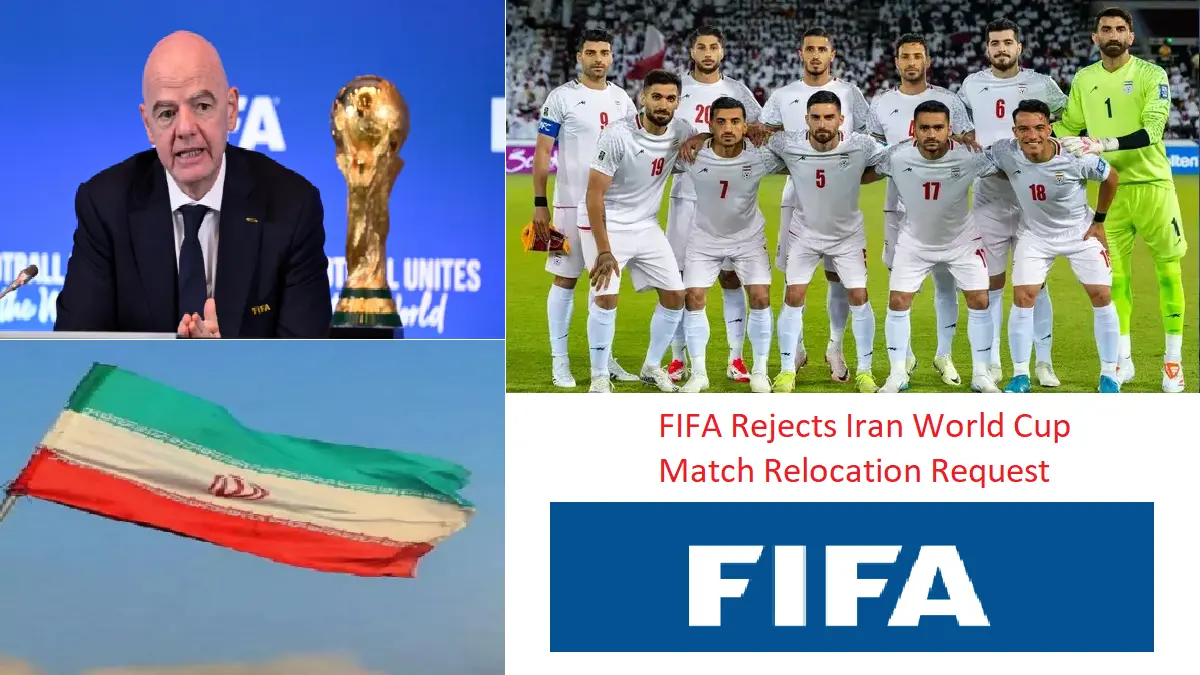
The FIFA rejects Iran World Cup match relocation request decision has drawn global attention, highlighting how rising geopolitical tensions are beginning to impact the FIFA World Cup 2026. Iran had asked to move its matches from the United States to Mexico, citing safety concerns, but FIFA has refused to alter the tournament schedule.
Why FIFA Rejects Iran World Cup Match Relocation Request
Iran officially requested FIFA to shift its group-stage matches due to growing security concerns for players, staff, and fans. The team is scheduled to compete in Group G alongside Belgium, Egypt, and New Zealand, with matches planned in major US cities such as Los Angeles and Seattle.
Iranian officials cited multiple concerns, including:
Rising Middle East conflicts and recent airstrikes
Security risks for players and supporters
Potential visa complications for Iranian nationals
Statements from former US President Donald Trump regarding safety guarantees
As an alternative, Iran proposed relocating matches to Mexico, another host nation for the 2026 FIFA World Cup.
FIFA’s Response: No Changes to World Cup Schedule
FIFA firmly rejected the proposal, emphasizing that altering match venues at this stage would severely disrupt tournament planning. With stadiums booked, tickets already sold, and global broadcasting arrangements finalized, any sudden change could create logistical chaos.
In response, FIFA made it clear that the current structure will remain unchanged. The FIFA Iran World Cup decision reflects the organization’s commitment to maintaining stability in a tournament of this scale.
FIFA stated that
The match schedule has been finalized since December 2025
Changes would impact multiple teams, fans, and stakeholders
All participating nations must adhere to the agreed structure
While FIFA continues dialogue with Iran, it has made it clear that the current schedule will remain unchanged.
Other News: 2026 FIFA World Cup Ticket: How and When to Buy Officially
Mexico Open to Hosting—But FIFA Says No
Mexico, one of the three official hosts of the 2026 World Cup alongside the US and Canada, had expressed willingness to host Iran’s matches if approved. Officials described the possibility as a logistical adjustment they were prepared to manage.
However, following FIFA’s rejection, the chances of relocation appear highly unlikely.
Will Iran Participate in the 2026 World Cup?
The situation has now raised a critical question: Will Iran play in the 2026 FIFA World Cup?
Although Iran has not withdrawn, participation remains uncertain due to the following:
Travel and diplomatic challenges with the United States
Safety concerns amid ongoing geopolitical tensions
Potential restrictions affecting players and officials
If Iran decides to withdraw, possible consequences include:
Financial penalties
Disqualification or future bans
Replacement by another qualified Asian team
FIFA may consider flexibility given the political sensitivity, but no official decision has been announced.
Why This Situation Is Highly Unusual
The 2026 FIFA World Cup is already historic, being hosted across three countries—the United States, Mexico, and Canada—and featuring an expanded format with more teams.
Relocating matches at such a late stage is rare due to:
Complex scheduling across multiple venues
Pre-arranged logistics and global broadcasting deals
High ticket demand and fan travel plans
While political tensions have previously forced sporting events to shift to neutral venues, such changes are extremely uncommon for a tournament as large as the FIFA World Cup.
What Happens Next?
FIFA is expected to continue discussions with Iranian officials in the coming weeks. A final decision regarding Iran’s participation may be made closer to the tournament or during an official FIFA meeting.
For now:
The schedule remains unchanged
Iran’s participation is uncertain
Global attention remains fixed on how politics may impact football
Conclusion
The FIFA rejection of Iran’s World Cup match relocation request decision highlights the growing intersection of global politics and international sports. While football aims to unite nations, ongoing geopolitical conflicts continue to influence major events like the World Cup.
Iran now faces a difficult choice—compete under current conditions or risk missing one of the world’s biggest sporting stages. As the 2026 tournament approaches, this developing situation could have significant implications for both football and international relations.
FAQs:
1. Why did Iran want its World Cup matches moved from the US?
Iran requested the relocation due to safety concerns linked to rising geopolitical tensions. Officials also highlighted potential visa issues and uncertainty around security guarantees for players, staff, and supporters traveling to the United States.
2. Why did FIFA reject Iran’s relocation request?
FIFA rejected the request because changing venues at this stage would disrupt tournament planning, including ticket sales, stadium bookings, broadcasting arrangements, and logistics for multiple teams.
3. Was Mexico willing to host Iran’s World Cup matches?
Yes, Mexico expressed willingness to host the matches as one of the 2026 World Cup co-hosts. However, after FIFA’s decision, the proposal is unlikely to move forward.
4. Could Iran withdraw from the 2026 World Cup?
Iran has not officially withdrawn, but uncertainty remains. If the team decides not to participate, it could face penalties, and another qualified team may be selected as a replacement.
5. What makes this situation unusual?
This situation is unusual because World Cup matches are rarely relocated so close to the tournament. The 2026 edition involves multiple host countries, making scheduling and logistics far more complex.
Related News: Iran Responds to Trump’s World Cup Comments Ahead of the 2026 FIFA World Cup
 Follow Us On Google News
  Follow Us On WhatsApp
Leave a Comment