

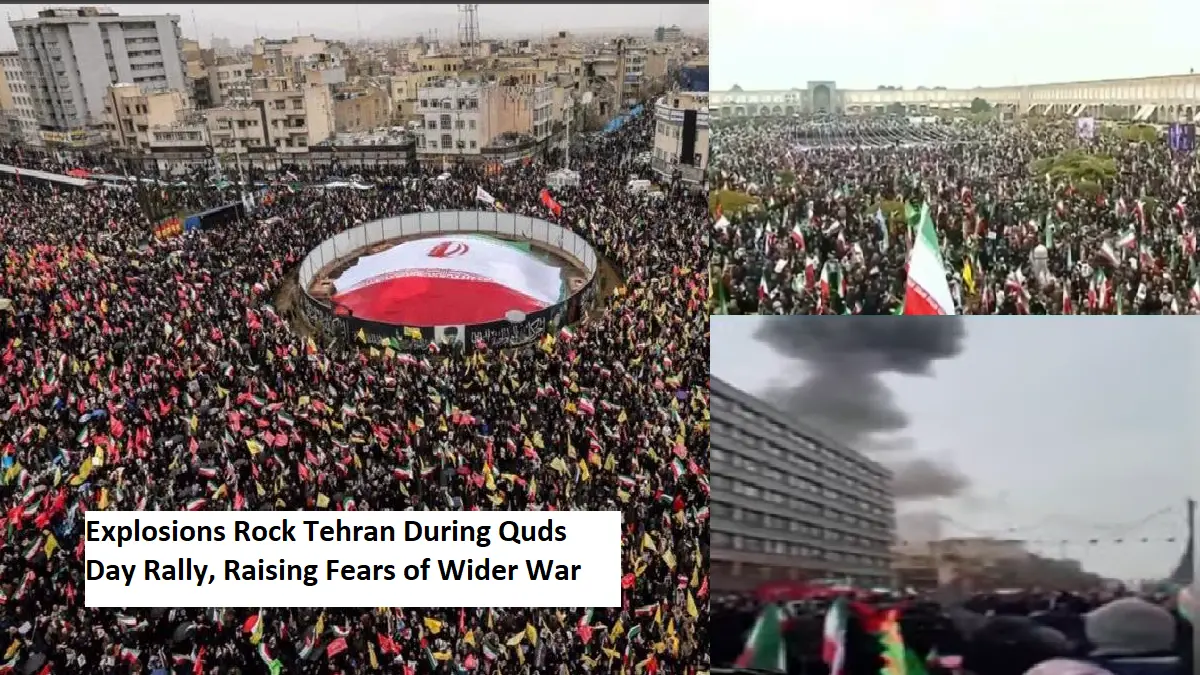
Explosions Rock Tehran During Quds Day Rally on Friday, creating panic among thousands of people gathered in Iran’s capital for the annual demonstration supporting Palestinians. The sudden blasts disrupted the massive gathering and intensified fears that the ongoing conflict between Iran and Israel could escalate into a broader regional war.
Explosions Rock Tehran During Quds Day Rally
The explosions occurred while crowds were marching through central Tehran during the annual Quds Day rally. The event, observed on the last Friday of Ramadan, traditionally features large demonstrations expressing support for Palestinians and opposition to Israeli control over Jerusalem, known as Quds in Arabic.
Witnesses reported hearing several powerful blasts near crowded areas, causing panic as people rushed to leave the rally route. Emergency crews quickly arrived at the scene while security forces blocked nearby streets and attempted to control the situation.
Initial reports suggested the explosions may have occurred near a major square and areas in southeastern Tehran, including the Javadiyeh district. While the exact cause of the blasts has not been officially confirmed, some reports speculate they may be linked to an airstrike or military-related target nearby.
Israeli Warning Before the Incident
The explosions happened shortly after Israel issued a warning that sites connected to Iranian military operations could become targets amid escalating tensions with Iran. Israeli officials have not directly claimed responsibility for the blasts.
The warning is believed to be connected to Israel’s ongoing military campaign known as Operation Lion’s Roar, launched earlier in 2026. The operation has reportedly targeted Iranian military infrastructure and suspected nuclear-related facilities in and around Tehran.
Iran Quds Day Rally Explosions Raise Regional Concerns
The Iran Quds Day rally explosions have intensified concerns about Middle East conflict escalation. The confrontation between Iran and Israel has already expanded beyond their borders. Military strikes, drone attacks, and missile launches have been reported across several parts of the Middle East, including Lebanon and areas near the Strait of Hormuz.
The rising tensions have also affected global markets. Concerns over potential disruption to oil shipments through the Strait of Hormuz have pushed global oil prices above $100 per barrel, raising fears of a wider energy crisis.
Cultural Sites Reportedly Affected
Local reports also suggested that nearby cultural landmarks and historic buildings in Tehran suffered damage from shockwaves caused by the explosions. International organizations have expressed concern, reminding all parties of international rules protecting heritage sites during armed conflicts.
Iranian officials have accused Israel of deliberately targeting areas near public gatherings and cultural locations, allegations that Israeli authorities have not confirmed.
Panic Among Civilians
Witnesses described scenes of confusion and fear as the explosions echoed across parts of Tehran. Many participants at the rally ran for safety while security personnel attempted to clear the area.
Some residents reported feeling buildings shake several kilometers away from the blast sites. Authorities have not yet released confirmed casualty numbers, and investigations are still underway to determine the exact cause of the explosions.
International Reaction
Governments around the world are closely monitoring the situation and urging both sides to avoid further escalation. Diplomatic channels are reportedly active as international leaders attempt to prevent the conflict from expanding into a full-scale regional war.
Several countries have issued travel warnings and are preparing evacuation plans for their citizens in the region.
What Happens Next
Analysts warn that incidents like the explosions during the Quds Day rally could mark a dangerous turning point in the confrontation between Iran and Israel. If retaliatory attacks continue, the conflict could draw in more regional actors and worsen humanitarian and economic consequences.
For residents of Tehran, uncertainty remains high as authorities investigate the blasts and the world watches closely to see how the crisis unfolds.
FAQ:
1. What happened during the Quds Day rally in Tehran?
Several explosions were reported during the annual Quds Day rally in Tehran. The blasts caused panic among thousands of participants who had gathered for demonstrations supporting Palestinians. Security forces quickly moved in and blocked nearby areas while emergency crews responded.
2. Were there any casualties in the Tehran rally explosions?
Authorities had not confirmed official casualty numbers at the time of initial reports. Investigations were still ongoing to determine the impact and the exact cause of the explosions.
3. What is Quds Day and why is it observed in Iran?
Quds Day is an annual event held on the last Friday of Ramadan in Iran and several other countries. Demonstrations typically express support for Palestinians and opposition to Israeli control of Jerusalem, which is referred to as “Quds” in Arabic.
4. Is the Tehran explosion linked to the Iran-Israel conflict?
Officials have not confirmed responsibility for the blasts. However, the incident happened during heightened tensions between Iran and Israel, leading analysts to warn about the risk of further escalation in the region.
5. Why are global markets reacting to the Iran-Israel tensions?
The Middle East conflict could threaten oil shipments through the nearby Strait of Hormuz, one of the world’s most important energy routes. Any disruption there can quickly push global oil prices higher.
6. How did people react to the explosions in Tehran?
Witnesses described scenes of confusion as people rushed to leave the rally area. Some residents reported hearing loud blasts and feeling buildings shake several kilometers away from the site.
7. What happens next after the Tehran explosions?
Authorities are investigating the cause while international leaders are urging restraint. Analysts say further escalation could widen the conflict across the Middle East if diplomatic efforts fail.
Other news: FBI Warns of Possible Iranian Drone Attack on California as West Asia Conflict Escalates
 Follow Us On Google News
  Follow Us On WhatsApp
Leave a Comment