

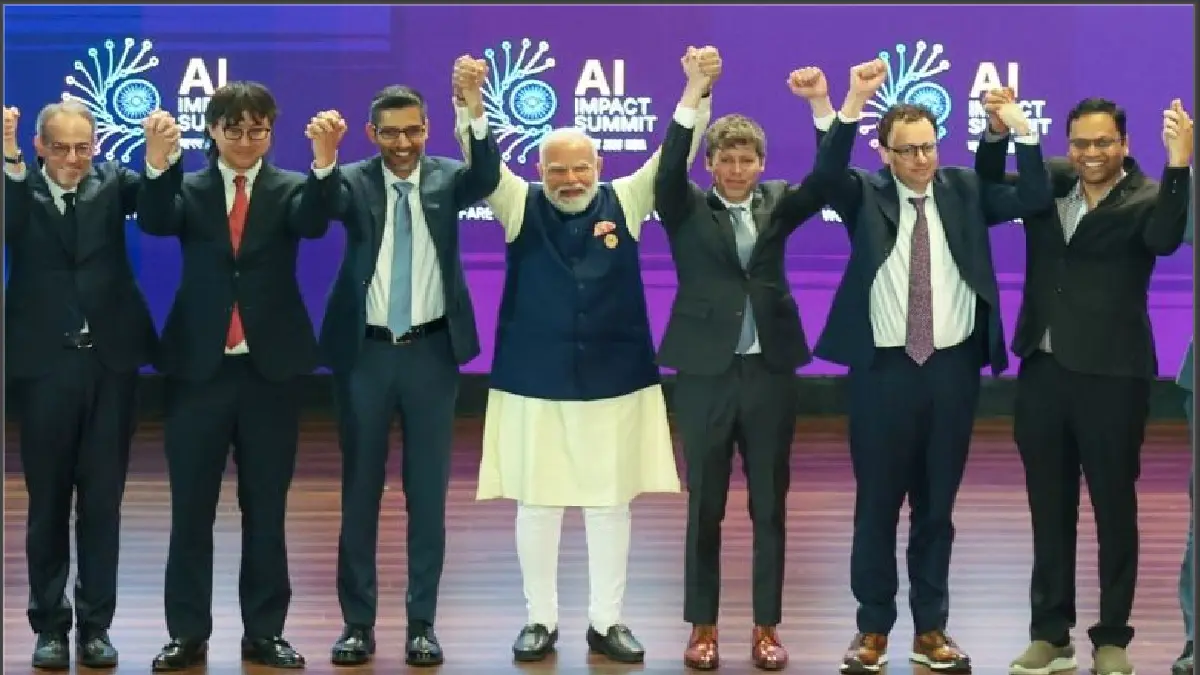
PM Modi Unveils MANAV Vision for Ethical AI at Delhi Summit as India positions itself as a global leader in responsible artificial intelligence development. Speaking at the India AI Impact Summit held at Bharat Mandapam in New Delhi from February 16 to 20, Prime Minister Narendra Modi introduced the country’s new AI framework titled “MANAV,” emphasizing that technology must serve humanity first.
The summit, which has drawn global tech titans and heads of state from over 20 countries, serves as a pivotal moment for India’s digital sovereignty. The summit, held from February 16 to 20, focused on the theme “Welfare for All, Happiness for All.” Leaders, policymakers, researchers, and technology executives gathered to discuss how AI can benefit both developed and developing nations, particularly countries in the Global South.
PM Modi Unveils MANAV Vision: What Is the MANAV Vision?
Central to Prime Minister Narendra Modi’s address was the introduction of the MANAV Vision
The word “MANAV” comes from Sanskrit, meaning “human.” It means putting humans first.
According to the Prime Minister, the framework stands on five guiding principles:
M – Moral and Ethical Systems: AI must align with human values and ethical standards and prioritize values over mere algorithms.
A – Accountable Governance: Clear regulations and oversight are necessary for AI deployment. Establishing clear, verifiable rules for AI behavior.
N – National Sovereignty: Countries must retain control over their data and digital infrastructure.
A – Accessible and Inclusive: AI tools should be available to all sections of society.
V – Valid and Legitimate: Artificial intelligence tools must operate within legal, reliable, and transparent boundaries.
In his address, Modi compared artificial intelligence to a GPS system—a tool that guides but does not replace human decision-making. “If directed properly, AI can transform lives; if misused, it can disrupt societies,” he noted, stressing the importance of keeping humans at the center of innovation.
India’s Global AI Ambitions
The India AI Impact Summit featured discussions on AI applications in agriculture, healthcare, education, and public services. Industry leaders, including Nandan Nilekani of Infosys, highlighted India’s potential to replicate its digital payments success story in the AI sector.
The Prime Minister also warned about emerging concerns such as child safety, misinformation, and surveillance risks, urging nations to collaborate on safeguards while promoting open innovation.
Challenges and Global Reactions
Delegates from developing nations expressed support for India’s approach, emphasizing the need to prevent monopolization by large tech corporations. Many agreed that AI governance must be inclusive and equitable, particularly for countries with limited technological infrastructure.
Despite minor logistical issues at the venue, the summit has been widely seen as a significant step in shaping global AI governance discussions. Additional sessions are expected to focus on AI safety standards and employment impacts.
A Human-Centered Future for AI
With the MANAV vision, India is signaling its intention to shape international AI policy through ethical leadership. As Narendra Modi stated, artificial intelligence should aim to make humanity wiser—not merely machines smarter.
The Delhi summit marks an early but ambitious move toward defining how nations can balance technological advancement with ethical responsibility in the rapidly evolving AI era.
Other Post: US Renews Threat of Military Action as Iran and Russia Announce Joint Naval Drills
 Follow Us On Google News
  Follow Us On WhatsApp
Leave a Comment