


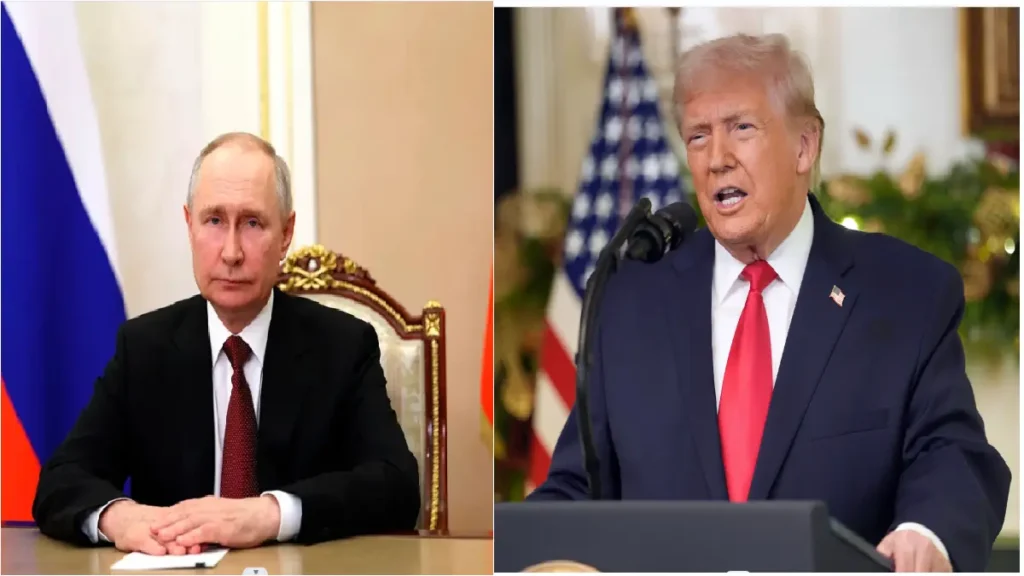
Putin signals $1 billion donation from frozen assets as Russian President Vladimir Putin said Moscow is prepared to contribute up to $1 billion from Russian assets frozen in the United States to support a proposed international peace initiative known as the “Board of Peace,” an organization promoted by U.S. President Donald Trump.
Putin said this during a late-night meeting of Russia’s Security Council, where he said the funds could be made available even before Russia formally decides whether to join the board. The proposed body is expected to focus on post-conflict stabilization and ceasefire oversight, with particular attention on ongoing crises in the Middle East.
Why Putin signals $1 billion donation from frozen assets
According to Putin, the proposed financial contribution reflects Russia’s long-standing position on conflict resolution and its historic relationship with the Palestinian people and will have a positive impact. He added that Moscow views the initiative as one that could contribute to broader international stability, provided its structure and objectives align with Russia’s foreign policy priorities.
Putin also said that once peace agreements are in place, Russia would be open to discussions with U.S. officials on the future use of remaining frozen assets. Those funds, he suggested, could potentially be directed toward reconstruction efforts in areas damaged by war, including regions affected by the conflict between Russia and Ukraine.
The comments come just days before a scheduled meeting between Putin and Steve Witkoff, a special envoy associated with Trump, where possible diplomatic approaches to ending the war in Ukraine are expected to be discussed.
Russia Yet to Decide on Formal Participation
While confirming that Russia has received a formal invitation to join the Board of Peace, he thanked Donald Trump for the invitation. Putin stressed that no final decision has been made.
He thanked Trump for the proposal and said Russia has always supported initiatives aimed at strengthening international stability. However, he made clear that participation in the board would depend on a careful review of its framework.
Putin said the Russian Foreign Ministry has been instructed to study the documents related to the board and consult with strategic partners before that; then Russia will respond to this invitation. Any involvement, he emphasized, would be guided by Russia’s broader foreign policy objectives and its international commitments.
He also rejected public suggestions that Russia has already agreed to join the board, saying the matter remains under consideration despite statements implying otherwise.
Putin Dismisses Trump’s Greenland Push
During the same address, Putin was asked about Trump’s renewed interest in acquiring Greenland, a proposal that has unsettled Denmark and raised concerns within NATO.
Putin played down the issue, saying Russia has no interest in Greenland’s future and does not view it as a matter requiring Russia ’s involvement. He said the question should be resolved directly between Copenhagen and Washington, without outside interference.
To support his point, Putin referred to historical examples of territorial transactions, including the United States’ purchase of Alaska from Russia in 1867 and Denmark’s sale of the Virgin Islands to the U.S. in 1917. While he criticized Denmark’s past treatment of Greenland, he said the issue itself does not concern Russia.
Global Response to the Board of Peace
Reactions to Trump’s proposed Board of Peace have been mixed across the world.
Seven Muslim-majority countries — Saudi Arabia, Turkey, Egypt, Jordan, Indonesia, Pakistan, and Qatar — have expressed readiness to take part in the initiative. These countries have highlighted their support for long-term peace frameworks, reconstruction efforts, and a permanent ceasefire in Gaza.
Israel has confirmed its participation, while several other countries, including Canada and the United Kingdom, have yet to make public statements. Nations that have already signed on include the United Arab Emirates, Bahrain, Hungary, Kazakhstan, and Vietnam.
The Vatican has confirmed that Pope Leo has received an invitation, though church officials have said more time is needed before a decision is made. Meanwhile, Slovenian Prime Minister Robert Golob has rejected the proposal, warning that it could undermine existing international institutions.
Concerns Over the Board’s Role and Authority
Despite being initially presented as a way to support peace efforts in Gaza, critics have raised concerns about the scope and mandate of the Board of Peace.
Observers have noted that the draft charter does not explicitly mention Palestinian territories and could overlap with, or potentially bypass, established United Nations mechanisms. Questions also remain about the board’s structure, authority, and long-term role.
As diplomatic discussions continue, uncertainty remains over whether the Board of Peace will take shape as envisioned—and whether Russia will ultimately decide to formally join.
Related Posts: Lindsay Halligan has resigned from her role as U.S. Attorney After Growing Pressure From Federal Judges