

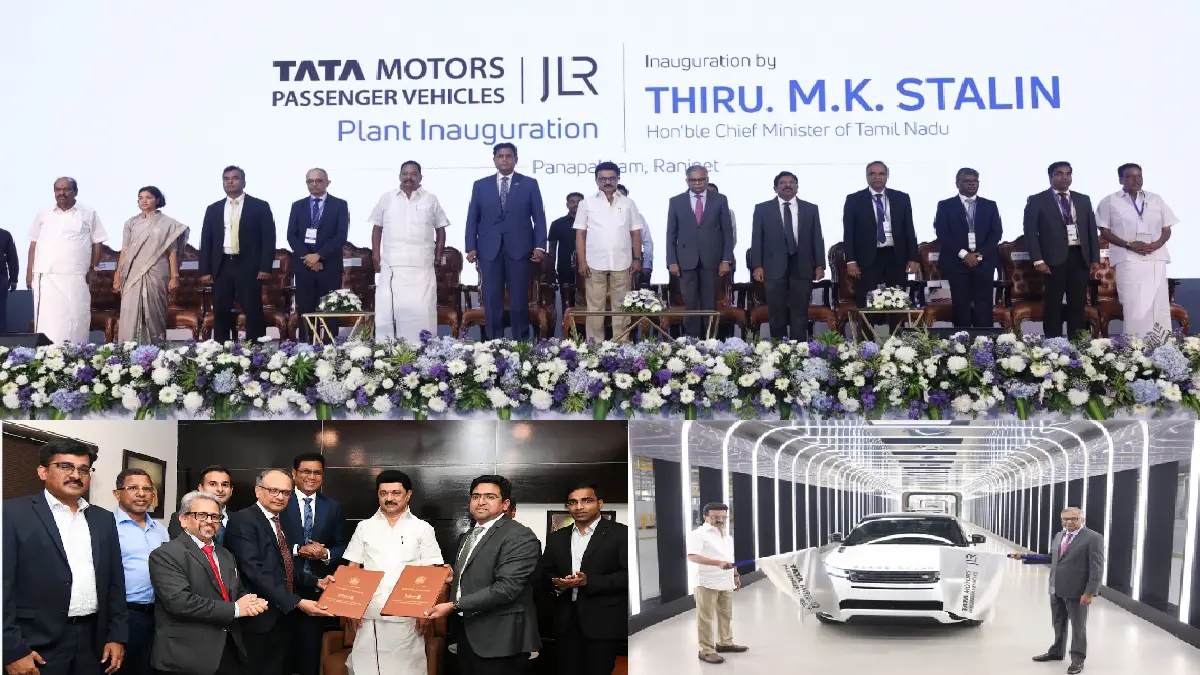
Tata Motors’ New Tamil Nadu Plant has officially begun operations, marking a significant step in the company’s domestic manufacturing expansion and global growth strategy. The state-of-the-art facility in Panapakkam represents an investment of nearly ₹9,000 crore and is expected to strengthen India’s position as a major automotive production hub.
The plant was inaugurated on February 9, 2026, with the first vehicle—a Range Rover Evoque—rolling off the assembly line. The event was attended by Tamil Nadu Chief Minister M. K. Stalin and Tata Sons Chairman N. Chandrasekaran, highlighting the strategic importance of the project for both the state and the Tata Group.
Tata Motors’ New Tamil Nadu Plant to Drive Local Production and Exports
Spread across approximately 470 acres in the SIPCOT industrial complex, the facility benefits from strong logistics connectivity, including access to ports and established supplier networks. Initially, the plant will focus on assembling Jaguar Land Rover (JLR) models using Completely Knocked Down (CKD) kits, with plans to expand production capabilities in the coming years.
Industry estimates suggest the facility could reach an annual production capacity of 250,000 to 300,000 vehicles. This expansion is expected to support both domestic demand and export markets, reinforcing India’s role in global automotive supply chains.
Employment and Economic Impact
The project is projected to generate more than 5,000 direct and indirect jobs, boosting employment and encouraging ancillary industries such as logistics and component manufacturing. State officials emphasized that Tamil Nadu continues to emerge as a preferred destination for global automotive investments due to its infrastructure and skilled workforce.
The rapid completion of the plant—reportedly within 16 months—has also been highlighted as a sign of efficient project execution and investor-friendly policies.
Focus on Sustainability and Future Technologies
Sustainability remains a key focus of the new facility. Tata Motors has incorporated renewable energy systems and water-positive practices into the plant’s operations, aligning with global environmental standards.
Looking ahead, the company plans to introduce electric vehicle (EV) production at the site, positioning the plant as a future-ready hub for next-generation mobility solutions. This aligns with India’s broader push toward electrification and clean energy transportation.
Strengthening Global Ambitions
With Tata Motors’ New Tamil Nadu Plant, the company aims to diversify its production footprint beyond existing facilities such as Chakan in Maharashtra. The move is expected to reduce logistics costs, improve supply chain efficiency, and enhance pricing flexibility in India’s growing luxury vehicle market.
As the plant scales up over the next five to seven years, it could become a central pillar in Tata Motors’ global expansion strategy, reinforcing India’s growing stature in the international automotive industry.
FAQ – Tata Motors Tamil Nadu Plant
1. Where is Tata Motors’ new Tamil Nadu plant located?
The new plant is located in Panapakkam within the SIPCOT industrial complex in Tamil Nadu, a major automotive manufacturing hub in India.
2. Which vehicle was produced first at the new plant?
The first vehicle produced at the facility was the Range Rover Evoque, assembled using Jaguar Land Rover CKD kits.
3. How much did Tata Motors invest in the Tamil Nadu plant?
Tata Motors invested around ₹9,000 crore to build the new manufacturing facility.
4. What is the expected production capacity of the plant?
Industry estimates suggest the plant could reach an annual production capacity of 250,000 to 300,000 vehicles once fully operational.
5. How will the plant impact employment?
The project is expected to create over 5,000 direct and indirect jobs, supporting local industries such as auto components and logistics.
6. Will the plant produce electric vehicles in the future?
Yes, Tata Motors plans to introduce electric vehicle production at the plant, aligning with India’s push toward EV mobility.
7. Why is the Tamil Nadu plant important for Tata Motors?
The new facility will boost domestic manufacturing, support exports, reduce logistics costs, and strengthen Tata Motors’ global expansion strategy.
Other Link: PM Modi Unveils MANAV Vision for Ethical AI at Delhi Summit
 Follow Us On Google News
  Follow Us On WhatsApp
Leave a Comment